By: Kelly D. Williams, Meryem Yilmaz Soylu, Jeonghyun Lee, and Alison Valk
Key words: virtual reality, visual rhetoric, digital pedagogy, assignments, exercises, reflections on teaching
This Photo by Unknown Author is licensed under CC BY-SA-NC
Introduction
VR is a simulated experience, often utilizing a head-mounted display (HMD), that immerses users in a three-dimensional environment (3D), allowing them to interact with lifelike digital worlds via multiple senses, including sight, sound, and touch. While gaming and entertainment devices created specifically for VR have been around since the 1960s, more recently, they’ve been incorporated into education (Valk et al 6). Studies have shown that VR applications positively impact student motivation, help learners gain deeper understandings of content, and increase student focus (Kavanagh et al 95). Yet a significant percentage of students have never tried VR in either a leisure or educational setting. More recently, instructors in disciplines such as health, science, and engineering have deployed VR, for example, to integrate games into problem solving, encourage hands-on exploration of 3D models, and implement badge or point systems to reach learning milestones. More research is needed, however, to assess the impact of this technology on writing instruction.
What role, if any, do these emerging technologies play in first-year composition courses, and more specifically, how can they advance the WCP’s guiding principles that communication is rhetorical – that is, communication is persuasive for a particular audience – and multimodal – communication is written, oral, visual, electronic, and nonverbal? In its unique approach to scaffolding interpretive awareness, VR excels in helping students decode nonverbal communication like expressive and emotional cues. Furthermore, VR offers composition students exciting opportunities to write from embodied perspectives. When students write from embodied experience they develop richer descriptive and analytical language to communicate with diverse audiences.
In Spring 2025, 41 students in Kelly Williams’s ENGL1102 course, “STEM Renaissance,” applied concepts of rhetoric and multimodal communication to two Shakespeare-related VR activities. About half of these students had never tried VR before. First, they analyzed Hamlet’s “to be or not to be” soliloquy in multiple modes: script, theatrical performance, film, and VR. Then, they explored a VR application, Sweet Sorrow, to perform scenes from Romeo and Juliet in a virtual theater space. Students were tasked with (1) assessing the efficacy of VR in reaching its intended audiences, and (2) evaluating how the fully immersive VR experience, at once multimodal and multi-media, changes how we experience psychological realism in Shakespeare’s tragedies. In a culminating assignment, students responded to a specific rhetorical situation in a written reflection: what would it be like to teach Shakespeare’s Hamlet, and what modes/media would be most helpful to teach your students psychological verisimilitude?
In what follows, we share how we integrated VR into the course, including activities and assignments we used, research methods and results, and insights for instructors who are interested in using VR for educational purposes. Ultimately, we argue that giving students access to emerging technologies helps them become better multimodal communicators. Specifically, VR encourages students to engage in the high impact practice of “learning by doing” as they translate difficult written texts across modes. Furthermore, utilizing VR can enable students to share their research with broader audiences as it promotes leadership skills. In becoming early adopters of VR, students can guide others in leveraging technology for effective communication, research, and collaboration, ensuring transference of multimodal communication skills beyond ENGL1102.
This essay shares insights based on IRB-approved research undertaken in three sections of ENGL1102 Composition II. The sections were taught by Williams and were supported by Alison Valk, GT Library’s Emerging Technologies Librarian, as well as the Center for 21st Century University’s (C21U) Meryem Yilmaz Soylu (Research Scientist II) and Jeonghyun Lee (Director of Research in Education Innovation). Students used Meta Quest 3 headsets provided by the GT Library.
Activities and Assignments
Shakespeare’s works, long studied for their rhetorical richness and performed in multiple modes, provided an ideal testing ground for exploring how VR reshapes rhetorical experience and interpretive awareness. After researching potential Shakespeare-related applications for VR, we decided to utilize the Shakespeare-VR Project, an educational initiative from Carnegie Mellon University’s Dr. Stephen Wittek. The following activities and materials reflect how we adapted Wittek’s curriculum for the multimodal composition classroom.
Activity 1: Multimodal Hamlet
Students first examined Hamlet’s famous “to be or not to be” soliloquy in its original modes and media. First, we studied the written script. In whole group discussion, the instructor and students performed a close reading of the speech with the aim of identifying examples of psychological verisimilitude (figure 1). Verisimilitude, in the literary sense, refers to the appearance of truth or reality in a work of fiction. It describes the extent to which a story, character, or setting seems believable and lifelike, even if the events themselves are imaginary or fantastical. In composition, writers of fiction and nonfiction alike achieve verisimilitude through details that reflect authentic human behavior and the use of language or imagery that resonates with the audience’s sense of what is plausible.
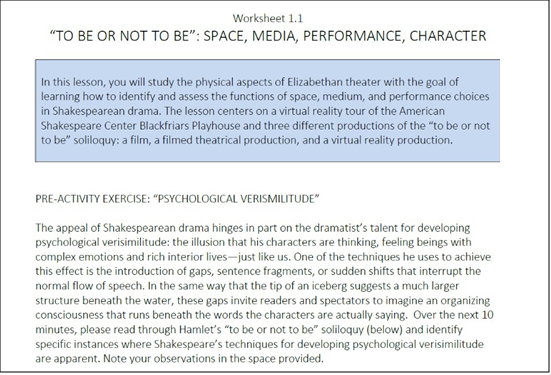
Figure 1: Close reading activity handout
Then, we viewed a recorded performance of the Royal Shakespeare Company’s (RSC) 2018 production starring Paapa Essiedu and directed by Simon Godwin. We chose this production for its modern twist on the character. Draped in a paint-stained suit, Hamlet is a playful figure in this reimagination, rather than the melancholic mourner we often see draped in dark robes. In the famous speech, he is surrounded by Basquiat-inspired artwork. Here, vibrant colors are Hamlet’s “suits of woe.” Splatters of paint figure an extension of his confusion and torment.
Paapa Essiedu’s ‘To Be Or Not To Be’ speech in Royal Shakespeare’s Hamlet
Next, students viewed “to be or not to be” in Kenneth Branagh’s 1996 film adaptation. Hamlet does not appear alone in the scene, as he often does in other productions. Here, he delivers his speech to his own reflection as the usurping King of Denmark and his meddling counselor, Polonius, eavesdrop behind a two-way mirror.
To be or not to be – Kenneth Branagh HD (HAMLET)
Finally, students watched the scene performed on a virtual Elizabethan stage via the HMD. In the VR iteration of the scene, students were placed on stage with the actor portraying Hamlet. Utilizing the 360-degree capabilities of the Meta Quest 3 headset, they could look out at the audience from the actor’s point of view, turn to face Hamlet, or look away entirely toward another point on the stage and only hear the actor’s voice in the distance.
For each performance (stage, film, VR), students observed verbal and nonverbal communication as well as spatial composition and recorded their responses in an online form (figure 2).[1]
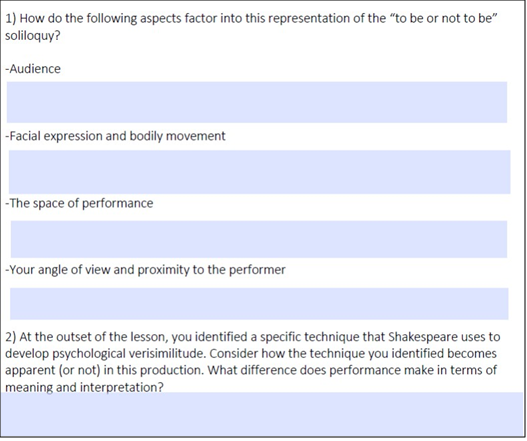
Figure 2: Example worksheet students filled out for each production of Hamlet.
Activity 2: Sweet Sorrow
The Sweet Sorrow application invites users to step into a digitally reconstructed Elizabethan playhouse and perform scenes from Shakespeare’s Romeo and Juliet. Created using motion-capture technology and animated 3D models, the experience “allows participants to speak lines alongside virtual actors, explore the stage space, and engage with Shakespeare’s text through embodied performance.” According to Wittek, the application is designed to function as a theatrical video game. Sweet Sorrow blends “historical authenticity with interactive storytelling.” Users choose a character, move freely through a virtual environment, and perform in key scenes—such as the iconic balcony and bedroom sequences—while text scrolls across the screen in karaoke-style prompts (Wittek).
During this short lesson, each student had a headset and acted the scene out at their seat, choosing either Romeo or Juliet’s lines to recite. During this individual VR scene work, students were encouraged to consider where in the text (1) their character’s lines prompted movement; (2) they interpreted cues for a certain way of speaking; and (3) they observed cues for interaction between Juliet and Romeo. We invited one student volunteer to cast the audio/video from their headset live on the screen for their peers to watch in the classroom. Students observed the verbal and nonverbal choices their peer made during the act of performance and reflected on how their choices were similar and different.
It’s important to note here that at least one student opted out of the VR experience. Because some students might experience motion sickness, instructors must provide alternative pathways to participate in the activity. In our case, the Hamlet VR scene was also available to watch on YouTube, so all students could access the performance in a way they were comfortable with. Additionally, in projecting a student’s Romeo & Juliet performance to classroom screen, all students could see what the VR environment looked like inside the headset.
After students participated in the “Multimodal Hamlet” and Sweet Sorrow activities, they composed a written reflection, using their notes to determine which mode/media most accurately communicated the psychological depth of Shakespeare’s tragedies. In this assignment, students assumed the following rhetorical situation: you are an educational technology consultant and your audience for this short proposal is a high school English teacher trying to decide if VR is the best way to teach their students the concept of “psychological verisimilitude.”
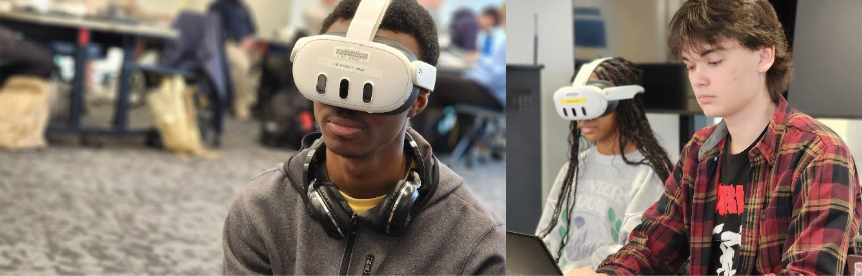
Figure 3: Students in ENGL1102 “STEM Renaissance” explore Hamlet in multiple media and modes. Photos courtesy of Yelena M. Rivera Vale, Communications Program Manager, C21U.
Research Methods and Results
The VR activities took place during class and served both as a hands-on learning experience and a small study of how immersion affects interpretation. Participation was voluntary, and 41 students completed pre- and post-surveys about their VR experience and comfort with the technology. The study protocol received approval from the university’s Institutional Review Board (IRB).
Most students were new to VR—only 17% owned a headset, and almost 40% had never tried it before. To help level the playing field, we started each session with a short walkthrough of the headset and controls, including tips for navigating and avoiding motion discomfort. We also cast one headset to the classroom screen so everyone could see what the virtual environment looked like.
Based on responses collected in the post-survey, 79% of students found the VR experience satisfying and 72% found it engaging. Many students who preferred Hamlet in VR often cited proximity in their reflections: VR is “most apt for teaching psychological verisimilitude since it completely transports the viewer into Hamlet’s world. Where film relies on controlled framing and static intensity, the theatrical version on audience interaction, VR lets students experience Hamlet’s hesitation firsthand.” For several students, this proximity led to greater comprehension: “Being up close forces me to pay more attention to every word spoken and helps me better understand hidden meanings and specific bodily gestures to convey train of thought.”
In their written reflections on multimodal Hamlet, about 51% of students said the RSC theatrical performance was the most effective way to communicate psychological verisimilitude. The film adaptation and the VR performance were split, with approximately 24% of students choosing each of these productions as the most effective portrayal of psychological verisimilitude.
Pedagogical Payoffs
VR offers writing and communication instructors unique ways to have students evaluate realism in the media they consume and create by way of comparison. In a given rhetorical situation, which modes and media will most authentically reflect human behavior, and what language or imagery will resonate with the audience’s sense of what is plausible?
Experiencing the same speech in several modes (written, oral, visual, electronic, and nonverbal) and various media (play script, theatrical performance, film, and VR), makes the concepts of multimodal affordances, constraints, and synergy tangible for students. As the data shows, students overwhelmingly preferred the theatrical performance for its oral and nonverbal affordances: “[Essiedu could] physically show the intensity of Hamlet’s conflict through his facial expressions and bodily language. He also has strategic gaps in his soliloquy, and the way his voice strengthens and falters is very engaging.” Students also prioritized this form of media because of the performative exchange between speaker and audience: “Shakespeare’s scripts were written for the stage and thus optimizes the medium it was intended for. The interactivity with the audience really makes it feel like the speaker is trying to personally connect to you.”
The extemporaneous interaction between audience and actors on stage can be understood through the lens of performance studies, where meaning is not fixed but co-created in the moment of exchange. Unlike the written text, which establishes a relatively stable framework of interpretation, live performance invites a dynamic reciprocity in which actors adjust tone, gesture, and pacing in response to audience cues such as laughter, silence, or applause.[2] Virtual reality, much like theatrical interaction, foregrounds the collaborative nature of interpretation, revealing how performance blurs the boundaries between creator and receiver. As Jonathan Kotchian reiterates in his chapter on communication and performance in WOVENText, being an effective communicator often means “being aware of and responsive to the culture in which communication is created and interpreted.”
VR helps students develop greater awareness of and responsiveness to verbal and nonverbal communication cues. Based on the qualitative data we collected, the following themes emerge from student responses (figure 3).
| Theme | Description |
| Expressive Movement | Gesture and physical movement convey meaning |
| Framed Distance | Sense of separation created by camera or staging |
| Emotional Resonance | Emotional response evoked by voice, expression, pacing |
| Embodied Realism | Feeling physically present in the performance |
Figure 4: Categorical descriptions of student responses
Expressive movement functioned as a key interpretive cue across modalities. It appeared most prominently in stage reflections, while film was often described as more restrained and controlled in its physical expression. Framed distance appeared most often in film reflections (n = 15). Film positioned students as observers outside the scene, while VR situated them as co-present participants within it. In their written responses to the film adaptation, students discussed realism as a result of production quality. In their reflections on theatrical performance, students described realism as live immediacy. However, in VR, realism was described by students in terms of spatial immersion. While, emotional connection appeared across all modalities, student reflections on VR stood out. According to students, VR’s ability to capture realism is described as (1) feeling emotionally close to the actor; (2) experiencing emotion as immediate; and (3) personal emotional engagement. Their reflections used first-person language like, “I felt like I was there.” Students also shared spatial descriptions: “I was standing near her.” Unlike their reflections on either film or stage, students were able to comment on presence-based framing during the VR activities: “I experienced it with her.” These reflections contrast with observer-based language in film and stage reflections.
Immersive environments support writing by helping students notice expressive and emotional cues. When students write from an embodied perspective in the way VR enables them to, they engage more deeply with interpretative awareness. VR does not simply change what students see. Rather, it changes how students position themselves as interpreters, an important shift for instructors who teach rhetorical awareness through reflective writing.
Future Applications
In getting to use cutting edge instructional technologies like the Meta Quest 3, Georgia Tech students gain the novel opportunity of assessing how VR’s fully immersive and multimodal environments impact communication and the exchange of information. WCP works to help our students become effective communicators through competency in using existing electronic/digital media and in using new media as they emerge and evolve. Integral to this task is one of WCP’s guiding questions: how does design influence the ways that an audience accesses, understands, and uses information? When students seek answers to this question by exploring virtual spaces, they are charting new territory, collecting and sharing qualitative data on the impacts of new media on audience reception.
Our major takeaways from the study are twofold: students desire more opportunities for collaboration in virtual spaces over a longer period. While they appreciate the multimodal experience of VR, students desire more hands-on, interactive elements instead of primarily passive experiences like videos: “Make it more interactive. That doesn’t necessarily have to be with new additions, but make sure to suggest that people move around, emphasize how they can interact with it, instead of just viewing it as a 360 video.” Additionally, they felt that the time allotted for VR activities was too short: “I would say allow the students to explore using the VR a little bit longer and potentially cut out some of the other activities, like a student acting out Romeo and Juliet or the second video clip.”
These initial experiences in classes that develop multimodal communication skills can lay the foundation for students to further explore emerging technologies in their academic or professional careers. By providing low stakes environments to experiment with newer technology, students are less likely to experience technology-phobia or reticence. Additionally, students who may not have been afforded opportunities to work with virtual reality prior to attending Georgia Tech are provided easy access to the technology and guidance in applications. Providing students with access to emerging technologies helps them develop diverse communication skills, enabling them to effectively share their research with a broad audience for example, using virtual reality to create immersive experiences that bring complex data or concepts to life. As students develop communication strategies that incorporate use of mixed reality, they also build leadership skills by becoming early adopters and innovators who can guide others in leveraging technology for research and collaboration.
Technical and Logistical Considerations
In closing, we offer faculty the following technical and logistical considerations to ensure effective integration of this emerging technology into their classrooms.
Accessing MetaQuest 3 Headsets
The library circulates two VR headset collections. A few headsets are available on a first come, first serve basis from the main info desk. These are part of the Instant Gadgets collection and have a loan period of a few days and are generally for personal use. The library also has a larger collection including 25 Meta Quest 3 headsets that can be reserved in advance for class or research activities. Technical specs and request information can be found at the following link: Georgia Tech XR Technologies. Once your request has been reviewed and approved, contingent on scheduling and support availability, a headset reservation link will be sent to you. The loan period for MetaQuest 3 headsets is one month, and there is a 7-day lead time, meaning you will only be able to see headset availability one week in advance. While it’s possible to ask your students to check out headsets individually for use in your class, we suggest the instructor check out multiple headsets to ensure adequate numbers.
When you submit your headset request, you will be asked to share information about your intended use and indicate if you’d like support from the library. We strongly recommend taking advantage of library support for smooth integration. Supporting librarians and researchers can assist in familiarizing students with the devices, designing learning activities, and testing proposed applications for use in classes. You can email the Emerging Technologies Librarian, Alison Valk, for more information. Once booked, MetaQuest 3 headsets will be available for pickup in the Gadgets Office (Price Gilbert Library Room G252). We strongly recommend building in several days of self-testing to retrieve the headsets and gain familiarity with the time needed to set up and start applications as this will help in project planning.
Scaffolding and Sequencing
Because VR is still an emerging technology, we need to acclimate our students to the virtual environment and offer guidance for safe use. We suggest dedicating one full class period to introducing students to the hardware. One option is to utilize center rotations, wherein some students work on a small-group activity, while others practice with the VR. Give students sufficient time to familiarize themselves with the headset and accomplish the following tasks: (1) adjust the headset straps and camera focus; (2) set up a boundary; (3) navigate the home screen and opening apps; (4) manipulate hand controls; (5) adjust hand gestures, body movement, and spatial awareness to the virtual space; (6) decide if they are more comfortable sitting or standing. We have found the Meta app, First Steps, very useful in accomplishing this step. Hardware familiarity in the early stages also allows students who are unsure about VR the opportunity to experiment, and in some cases, opt out of use.
Once students are familiar with the headset and controllers, it’s good practice to embed video tutorials in your Canvas course site related to the software/app you will use during instruction. Students can watch app tutorials during class as part of a center rotation, or for homework outside of class. When choosing an app for instructional use, you may consider one that isn’t dependent on VR. Many apps offer free software downloads for laptops and mobile devices, as well as web-based platforms, so that students who opt out may still engage their peers in their preferred modality. Interested instructors may reach out to Kelly Williams or Alison Valk for app suggestions.
Physical Space and Safety
If you plan for students to use VR simultaneously, you will need to ensure adequate space to accommodate movement. While many of our classrooms may be manipulated to accommodate this kind of activity, several do not. In these instances, we suggest working with the library to book one of their classrooms. If you requested library support on the day of VR instruction, it’s helpful if you and the support staff station yourselves throughout the space to create supervised movement zones. While in our experience it’s a rare occurrence, some students may experience motion sensitivity. Be proactive and have drinks on hand (water, ginger ale) and saltine crackers to offer students who may experience dizziness. The maximum recommended time spent using VR is 30 minutes. Ensure a cleaning protocol for headsets. Keep cleaning products on hand so that you or your students can sanitize the hardware before the next use.
Works Cited
Kavanagh, Sam, Andrew Luxton-Reilly, Burkhard Wuensche, and Beryl Plimmer. “A Systematic Review of Virtual Reality in Education.” Themes in Science Technology Education, vol. 10, no. 2, 2017, pp. 85 – 119.
Kay, R.H., Loverock, S. “Assessing emotions related to learning new software: The computer emotion scale.” Computational Human Behavior, vol. 24, no. 4, 2008, pp. 1605–1623.
Kotchian, Jonathan. “Considering Communication: Performance, Difference, Language, & Culture.” WOVENText. https://sites.gatech.edu/woventext/chapter-8-considering-communication-performance-difference-language-culture-2/.
Valk, Alison, Ximin Mi, and Ashley L. Schick. Making Virtual Reality a Reality: Designing Educational Initiatives in Libraries with Emerging Technologies. Bloomsbury, 2023.
Wittek, Stephen. “Lesson Plans.” The Shakespeare-VR Project. https://shakespeare-vr.library.cmu.edu/lesson-plans/.
Wittek, Stephen. “Sweet Sorrow.” The Shakespeare-VR Project. https://shakespeare-vr.library.cmu.edu/lesson-plans/.
Additional Notes
[1] The psychological verisimilitude close reading activity, as well as the “to be or not to be” worksheet are adapted from Wittek’s lesson plan materials.
[2] This interplay exemplifies Mikhail Bakhtin’s concept of dialogism, as the stage becomes a space of polyphony where multiple voices—those of the playwright, the performers, and the spectators—converge to generate meaning.


