EggHead 21

Check. Continue reading
Posts that focus primarily on teaching and pedagogy.
Check. Continue reading
Bodies, a personal yet strangely distant subject matter for most students to discuss, provide a ripe lens through which to hone the skills that composition classrooms aim to foster. As mediums of communication, bodies afford us multiple ways to express ourselves: through gestures, facial expressions, vocal tone, and body language… Continue reading
Editor’s Note: When I first had the idea to teach an English 1102 course about the The New Yorker magazine, I had hoped that Thomas Lux, who has published five poems in the magazine, would come speak to my students. Vijay Seshadri, former editor at The New Yorker and frequent contributor to the… Continue reading
Two days after President Trump’s inauguration, on January 22, 2017, the newly-minted Counselor to the President Kellyanne Conway appeared on NBC’s Meet the Press with Chuck Todd. She discussed White House Press Secretary Sean Spicer’s first press briefing the night before, in which he claimed, despite the existence of much… Continue reading
On March 30, 2017, the Writing and Communication Program’s World Englishes Committee hosted the faculty roundtable “Instructing Non-Native English Speakers: Practical Tools.” This event drew Georgia Tech teaching faculty and staff interested in sharing ideas and learning new strategies for better serving the needs of the diverse population of English… Continue reading
On Tuesday, March 14, Georgia Tech hosted a screening of the documentary CODE: Debugging the Gender Gap. The 2015 film, which played at various film festivals and tech events such as the 2015 Grace Hopper Celebration of Women in Computing, examines the lack of gender diversity in the American software… Continue reading
On the morning of March 8, 2017, I, like many women around the country (and perhaps the world) faced a particular question: should I go to work? On this particular day, the question was triggered by International Women’s Day and its attendant call for a women’s strike. Named “A Day… Continue reading

In honor of National Poetry Month, Brittain Fellow Jeff Fallis returns to the podcast to discuss what may be literature’s most ill-defined, misunderstood, and maligned genre. As recipients of 2016-2017 Poetry@Tech Pedagogy Grants, Jeff and I talk about some of the ways that we have integrated poetry into our composition classrooms,… Continue reading

Toby takes over the podcast this week, in the first installment of a three-part series in which we address the past, present, and future of the Marion L. Brittain Postdoctoral Fellowship. In this episode, he interviews Brittain Fellow Halcyon Lawrence about her background and research in information design and experiences… Continue reading
On March 14, 2017, the Georgia Tech teaching community gathered for Celebrating Teaching Day, a demonstration of the innovative pedagogies that feature in courses across Tech, put on by the Center for Teaching and Learning. The inventive work of Brittain Fellows was on prominent display during the day’s events via a series… Continue reading

Last fall, I led students through a writing and communication course titled “One World is Not Enough.” This class investigated cultural values and ideologies as exhibited in the narratives that societies construct and consume. The course focused on two contemporary novels, Stephen Graham Jones’s Ledfeather and Haruki Murakami’s Kafka on… Continue reading

This week on the podcast, Toby and I talk about The New Yorker magazine––which I happen to be teaching an English 1102 course about this semester. Along the way, Toby shares a cartoon by Tom Toro and reads from “Sadness Lamp F.A.Q.” by Sarah Hutto (both of which can be found in the March 13,… Continue reading
When teaching the art of research writing, I aim to help my students learn the tools of the communication trade through assignments that challenge them to see the world with more conscientious eyes. I strive to help my students recognize not only that the forms of their words matter but that… Continue reading
On the occasion of Betsy DeVos’s confirmation as U.S. Secretary of Education, Toby takes over the microphone to school me on the history of public education. The podcast can be played using the embedded player above or downloaded as an mp3 file. Music: “Me and Julio Down by the Schoolyard,”… Continue reading

The outcome of the 2016 presidential election has thrown a number of institutions into crisis––or at least deep soul-searching: the news media, the Electoral College, the Democratic Party, libraries, humanities departments, and the university more broadly. The first-year composition classroom, in particular, faces newly urgent pedagogical challenges in the wake… Continue reading

This fall, I have been teaching a section of first-year composition I call “Science in Public.” The course’s thematic focus—public-facing science communication—prompts students to consider how journalists, artists, activists, researchers, and other communicators compose texts about the sciences that engage and move to action a broad, nonspecialist audience. Students adapt… Continue reading
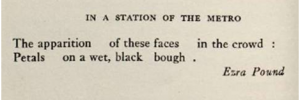
Modernism, they say, began in the magazines. Long before internet streaming and wireless television, newspapers and periodicals were the first mass media, offering authors, intellectuals, and social activists a dramatically wider domain for their artwork and ideals. These print media provided a vital outlet—and at times a much-needed sanctuary—for modernist… Continue reading
On this week’s podcast, Toby and I are joined by Brittain Fellows Anna Ioanes and Jennifer Forsthoefel to discuss our experiences, realizations, thoughts, and fears as teachers and scholars in the week since Donald J. Trump was elected President of the United States. We begin by discussing Daveena Tauber’s “Post-Election… Continue reading
30% funny…. Continue reading
An Elysian vision. Continue reading
Academic time. Continue reading
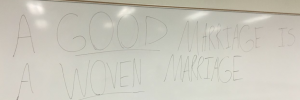
My English 1102 class, “Odd Victorian Bodies,” uses the lens of nineteenth-century British literature to study the concepts of multimodal–or WOVEN (written, oral, visual, electronic, and nonverbal)–communication. The class reads Victorian novels, short stories, and poetry that deal explicitly with bodies. In addition to learning about a historical time period,… Continue reading

In this brief episode, Toby attempts to comment on academic parenting (and fatherhood in particular) . . . while academic parenting. His comments are drawn from Aviva Shen’s article on student perception and gender bias, Apoorva Mandavilli’s New York Times piece on representation in academia, Dale Edwin Murray’s Times Higher Education essay on the impossibility… Continue reading
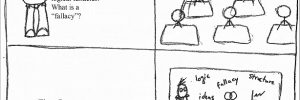
The danger of fallacies. Continue reading